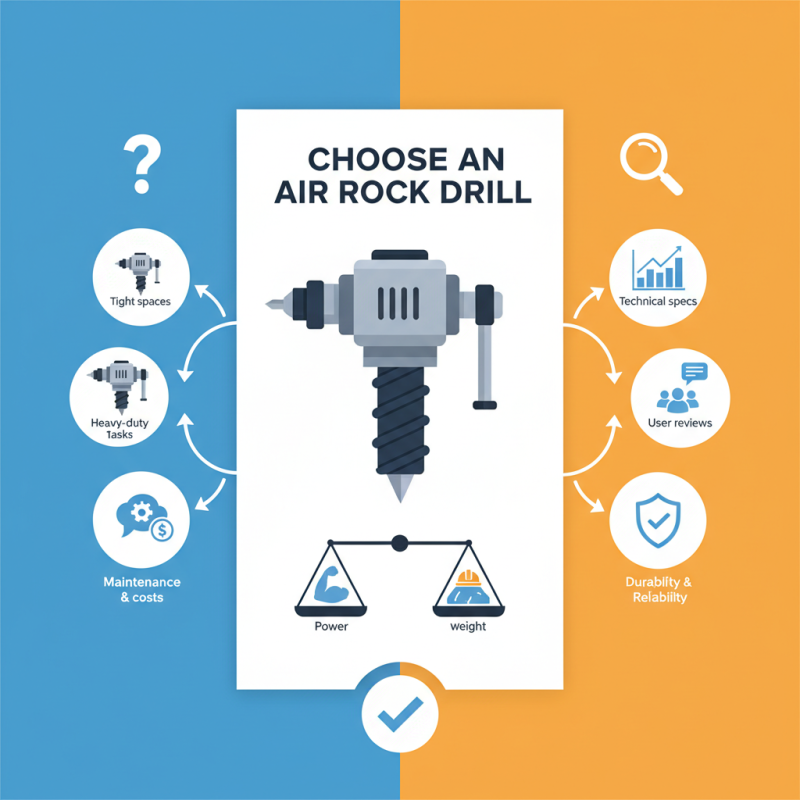
Choosing the right Air Rock Drill can significantly impact your projects. Understanding your needs is essential. The market offers various models, each with unique features. A good Air Rock Drill must balance power, weight, and durability.
Consider your specific requirements before making a choice. Are you working in tight spaces? Or do you need a drill for heavy-duty tasks? The size and design of the drill matter greatly in these scenarios. Analyze the technical specifications and user reviews. They provide insight into the drill’s performance and reliability.
Selecting the wrong Air Rock Drill can lead to inefficiency. It may not work as expected, or it could result in accidents. Often, buyers overlook long-term maintenance costs and spare parts availability. These factors also influence the overall value of the drill you choose. A thoughtful evaluation ensures you invest in a tool that meets your needs effectively.
When selecting an air rock drill, understanding its key features and specifications is crucial. Look for a drill with a lightweight design. This can enhance maneuverability and reduce operator fatigue during extended use. Pay attention to the power-to-weight ratio, which directly impacts efficiency and performance. A drill with a high RPM can drill faster, leading to increased productivity.
Tips: Always consider the power source. A reliable air compressor is essential for optimal functionality. Examine the drill's pressure and air flow requirements to match your compressor capabilities. This prevents operational issues and ensures a smoother drilling experience.
Durability is another vital aspect. Look for robust materials that withstand harsh conditions. Some drills may appear sturdy but could fail under heavy use. A well-constructed drill should offer long-term reliability without frequent maintenance. Testing the drill in practical scenarios can help identify any flaws or limitations.
When selecting an air rock drill, assessing job requirements is crucial. The specific application will significantly influence your choice. For example, some drilling projects require more power, while others need versatility. According to industry reports, projects involving hard rock formations may demand drills with higher torque and impact energy, often exceeding 20 joules per blow. Conversely, softer materials may be efficiently managed with lighter equipment.
Consider the operating environment as well. Drills designed for confined spaces must be compact. A report from the Construction Industry Institute highlights that up to 30% of delays on jobs stem from inefficiencies in equipment. Additionally, weight and portability matter. Heavy drills can affect mobility and may slow project progress.
Maintenance and operational costs also cannot be overlooked. Research indicates that companies can save up to 25% on costs with equipment that offers easier servicing. A drill with complex maintenance requirements can disrupt workflow. Thus, evaluating these factors helps ensure that you choose an air rock drill suited for your specific needs and conditions.
When selecting an air rock drill, understanding brand performance is crucial. Recent industry reports indicate that the top brands account for over 70% of global market share. These leaders are known for their innovative technology and reliability. However, second-tier brands are gaining traction, often offering competitive features at a lower cost.
Many users still report mixed experiences with lesser-known brands. They sometimes deliver unexpected performance variances. Reliability issues can break trust. Some professionals suggest testing products before full commitment. Each brand’s warranty and support service should also influence decisions.
Market dynamics continuously shift, impacting brand popularity. Data shows mid-range brands are slowly increasing their market presence. This trend suggests a potential value opportunity for budget-conscious buyers. Yet, caution is still necessary. Users need to weigh brand loyalty against performance metrics thoughtfully. Understanding these nuances will enhance your purchasing confidence.
When selecting an air rock drill, performance metrics are crucial. Power determines how effectively the drill can penetrate tough materials. According to industry reports, a drill with a power rating of 30-40 psi offers optimal performance. Efficiency is equally important. Studies show that tools designed for high efficiency can reduce energy consumption by 20-30%. This not only saves costs but also minimizes wear and tear.
Durability plays a vital role in long-term performance. A robust air rock drill should withstand harsh conditions, ensuring fewer breakdowns. Some models report a lifespan increase of up to 50% with proper maintenance. Regular inspection of components can help identify issues before they affect operation.
Tips: Look for drills made with high-grade materials. Longevity is often linked to the materials used in construction. Pay attention to user reviews as well. Real-world experiences can reveal much about a drill's reliability. Having a backup plan for maintenance is essential. It's easy to overlook, but it can save time and money in the long run.
Maintaining an air rock drill is crucial for achieving optimal performance and longevity. Regular inspections can prevent costly repairs. Research indicates that over 30% of tool failures arise from inadequate maintenance practices. It's vital to check for wear and tear on components such as drill bits and hammers. These parts are subject to intense stress, and minor damages can significantly impact efficiency.
Proper lubrication is another key aspect of maintenance. According to industry studies, tools maintained with the correct lubricants last up to 50% longer. Be sure to check your drill’s manual for lubrication intervals. Additionally, dust and debris can hinder function. A thorough cleaning after each use can help avoid build-up.
Every drill will require different attention. Failing to adapt maintenance procedures can lead to inefficiencies or even safety hazards. Users should track the drill’s performance over time. Adjusting maintenance routines based on this data can lead to better performance. Listening to user feedback is equally important. It can reveal unexpected issues that standard procedures may overlook.
: Power affects how well the drill can penetrate tough materials. A rating of 30-40 psi is often optimal.
High-efficiency tools can reduce energy use by 20-30%. This helps save costs and minimize wear.
Durability ensures the drill can handle harsh conditions, resulting in fewer breakdowns and longer lifespan.
Regular inspections can prevent expensive repairs and help catch issues early. This is very important.
Proper lubrication can extend tool life by up to 50%. Check the manual for correct lubrication intervals.
Dust and debris can hinder performance. Cleaning after use helps avoid build-up and maintains functionality.
Monitoring the drill’s performance over time helps adjust maintenance routines for better outcomes.
Feedback can highlight unexpected issues that regular maintenance may miss, improving overall drill care.
Inadequate maintenance can lead to inefficiencies and safety hazards. It's crucial to maintain diligence.
High-grade materials are linked to longevity. Material quality directly influences performance and durability.
When selecting the best Air Rock Drill for your projects, it is essential to understand its key features and specifications, including power, efficiency, and durability. Assessing your job requirements will help you identify the factors that influence your drill selection, ensuring you choose a model that meets your specific needs.
In addition, comparing different Air Rock Drill brands can offer insights into industry leaders and market share, guiding you toward reliable options. Evaluating performance metrics is crucial for determining how well a drill will perform under various conditions. Lastly, considering maintenance practices is vital for ensuring the longevity and optimal functioning of your chosen Air Rock Drill, ultimately leading to better outcomes for your drilling tasks.

KAT DRILLING